
Sacred Minds: Autism, Dignity, and the Call to Love 🕊️
.Autistic children are not broken. They invite us to more empathy, respect, and a new way of loving beyond labels, combining science, humanity, and spirituality Autism
✍️ Autor: André Nascimento
12/15/20253 min ler
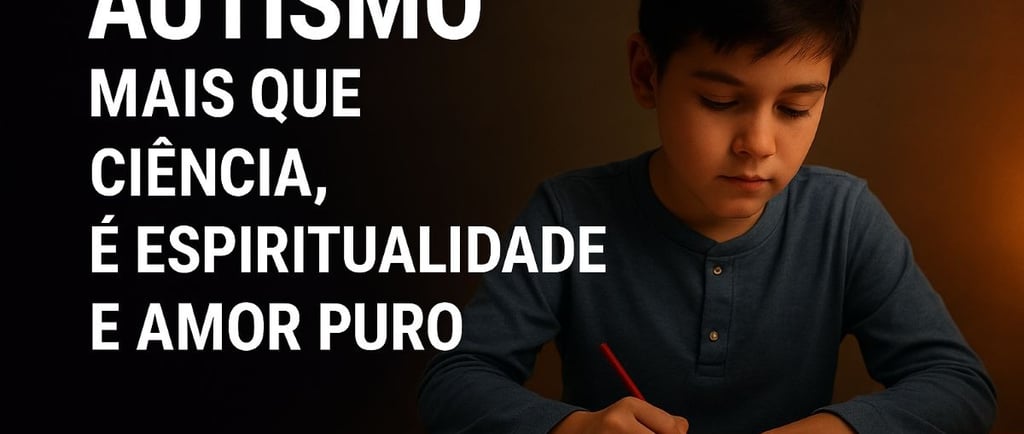
In a world that wants quick explanations for everything, autism resists being simplified. Clinical definitions describe Autism Spectrum Disorder (ASD) as a neurodevelopmental condition marked by differences in social communication, behavior, and sensory processing. At the same time, autistic people and their families talk about intense sensitivity, unique forms of intelligence, deep focus, and ways of relating that do not fit into “normal” boxes.
More and more, the conversation is shifting from “how do we fix this?” to “how do we build a world where this child can live with dignity?”. This change of perspective moves us from deficit to diversity. When society adapta itself to different ways of being, it is not only the autistic child who grows; the whole collective matures.
1. What science really says about autism 🧠
Organizations like the American Psychological Association and the World Health Organization describe autism as a spectrum of lifelong neurodevelopmental differences. Common features include challenges in social interaction and communication, restricted interests, repetitive behaviors, and atypical sensory responses, expressed in very different ways and intensities from person to person.
Recent neuroscience studies suggest differences in brain networks involved in perception, attention, and integration of information, which means autistic brains organize the world differently, not simply “worse”. That helps explain why many autistic people show intense focus, original problem‑solving, atypical learning profiles, and very specific talents.
2. The danger of romanticizing or reducing autism 💙
Seeing beauty and meaning in autistic experience does not mean denying the real challenges. Many autistic children and adults face sensory overload, communication barriers, bullying, misunderstanding, burnout, and lack of access to therapies, education, and inclusive services. Families often live with exhaustion, worry, and the weight of navigating systems that were not designed for neurodivergent people.
On the other hand, reducing autism to “disorder”, “tragedy”, or “burden” erases identity and potential. Autistic self‑advocates insist on a crucial point: nobody is only a diagnosis. A respectful view of autism balances both sides – recognizes support needs and rights, while also seeing the autistic person as a subject with desires, limits, strengths, and a valid way of being.
3. Love, presence, and communication: the role of families and communities 👨👩👧👦
Research shows that the communicative and emotional environment around the autistic child has a direct impact on quality of life and development. When parents, caregivers, teachers, and professionals learn to read signals, adjust expectations, respect regulation needs, and celebrate small steps, bonds become safer and the child is more willing to explore and engage.
In this sense, “healing” is not about erasing autism, but about reducing the suffering created by isolation, misunderstanding, and rejection. Adapting communication, offering predictable routines, accommodating sensory needs, and valuing special interests are practical forms of love in action. Beyond any spiritual interpretation, these children need something very concrete: people willing to meet them where they are.
4. Spiritual meaning without losing ethical ground 🌌
Many families turn to spirituality to find meaning and strength, seeing their autistic children as highly sensitive souls that invite others to practice patience, compassion, and unconditional love. While this language does not belong to science, it can help some people reframe their journey, as long as it does not replace evidence‑based care or create guilt or unrealistic expectations.
Any spiritual approach needs a clear ethical filter:
Does it respect the child’s dignity and autonomy?
Does it encourage inclusion, protection, and access to support?
Or does it place the burden of “saving” or “healing” others on the child’s shoulders?
Used with care, spirituality can walk alongside medicine, psychology, and education as a source of comfort and resilience, not as a denial of reality.
5. What autism reveals about us as a society 🌍
When an autistic child enters a school, a family system, a faith community, or any public space, they expose how ready (or unready) that environment is to welcome difference. The WHO points out that there are still major gaps in early diagnosis, access to services, and social inclusion, especially in low‑ and middle‑income countries.
This shows that the “problem” is not located only in the individual, but also in structures, policies, and attitudes. Every step toward accessibility – teacher training, sensory‑friendly spaces, inclusive education, anti‑stigma campaigns – is a step toward acknowledging there is no single correct way of being human. Autism, then, becomes not just a clinical topic, but a mirror of our collective capacity to care.
Constructive critique 🌱
Texts that connect autism and spirituality often risk two extremes: romanticizing autistic children as “angels” or “little masters” and ignoring their daily struggles, or treating them solely as clinical cases without acknowledging families’ emotional and existential experiences. To deepen this article, it would be important to:
include more first‑person accounts from autistic adults;
emphasize that any spiritual meaning must never replace therapies, education, and supports;
and explicitly address structural issues like poverty, lack of services, and discrimination, which strongly shape autistic lives.
Contato
Apoio e dicas sobre saúde mental.
Redes
+55 11980442159
© 2025. All rights reserved.