
Horse Behavior 🐎: From Foal to Adult and Beyond
Explore horse behavior 🐴 from young foal to adult: equine training, defense instincts, equine therapy, and human connections. In-depth scientific analysis.
Frequência cardíaca perfeita do cavalo & campo de 3m sincroniza com humanos, tratando TDAH, impulsividade & defeitos congênitos. Equinoterapia equilibra corpo e cérebro. Ciência revela!
4/6/20263 min ler
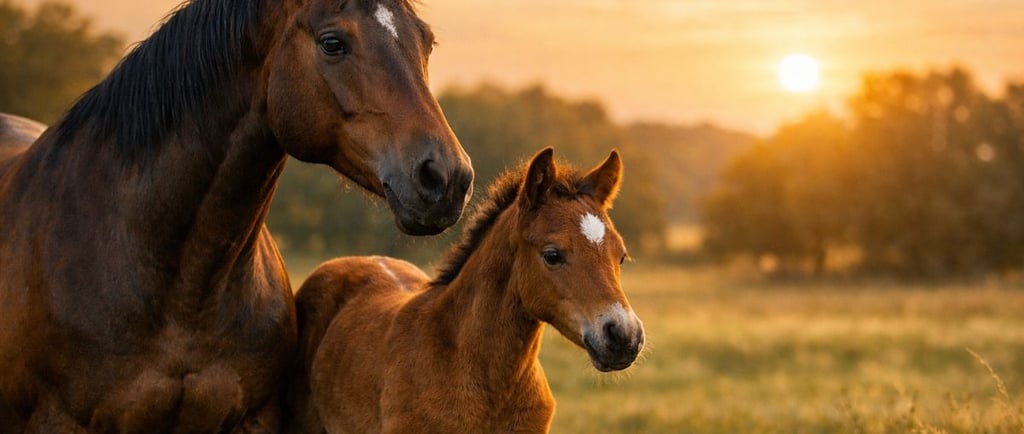
Horses display behavioral patterns shaped by millions of years of evolution as prey animals, influencing everything from birth to adulthood. 🐣➡️🐎 This article delves into these aspects based on recent veterinary and ethological studies, covering training, defenses, equine therapy, and human interactions. 📚
Development from Youth to Adulthood 🌱
Foal Stage: Play and Early Socialization 🥰
In the neonatal and young phase, foals exhibit playful behaviors like play behavior, crucial for musculoskeletal and social development. 🎾 Studies show early controlled exercise promotes bone adaptations, with foals born responsive to light stimuli. 💪 Socialization in groups with adults teaches boundaries, reducing future aggression; isolated foals may develop poor habits. 👥
Bone maturity varies by breed, with radial distal epiphyseal closure around 24-27 months in Thoroughbreds, influenced by age but not sex. 🦴 Behaviors like grazing, resting, and mutual grooming strengthen group bonds, preparing for independence. 🌿😴
Transition to Adult Life 🚀
By age 4, horses reach full maturity, with adult size and mental capacity for advanced training. 👨🦰 Athletic careers often start at 30-35 months, averaging 20 months and 18 races, benefiting from controlled early starts. 🏇 Adults maintain social hierarchies, constant environmental awareness, and domestication adaptations. 👑
Equine Training 🎓
Average Times and Variations by Purpose ⏱️
Training begins with 15-20 minute daily sessions for basic habituation, progressing based on individual response. 🕒 General initiation takes weeks to months; in events like barrel racing, conditioning includes 10-minute warm-ups, courses, and 40-minute physiological recovery. 🔥 Variations depend on breed and purpose: Quarter Horses in intense training show lactate spikes needing rest; jumpers average 72-minute initial sessions. 🐎💨
Training scales prioritize rhythm, relaxation, and contact, respecting natural gaits (walk, trot, canter). 🎶 Genetics and handling influence outcomes, with young foals adapting more flexibly. 🧬
Horse Defense Mechanisms 🛡️
Primary Instincts and Responses ⚡
Horses trigger flight and defense instincts as evolutionary prey, prioritizing escape in open spaces with 340° vision. 🏃♂️ In confinement, claustrophobia leads to kicks or panic; isolation causes anxiety. 😨 Behaviors include constant vigilance, quick movement, and reactions to simulated predators. 👀
Ethological studies confirm these persist in domestication, with emotional responses to stimuli like anger or fear. 🧠
Equine Therapy: Science and Applications ❤️🩹
Benefits and Scientific Evidence 🌟
Equine therapy leverages the horse's three-dimensional movements to enhance balance, motor coordination, and cognitive functions, strengthening postural muscles. 🏃♀️ Research shows motor and socio-emotional gains in neurodivergent children, reducing stress via heart rate synchronization. 📈❤️
Horse Preparation and Selection Criteria 🩺
Selected horses have docile temperaments, good character, balanced diets (hay and feed), clean stalls, and up-to-date vaccinations. 🥬💉 Centers like IF Goiano assess behavioral welfare for therapy use. ✅ Preparation includes socialization and calm interaction training. 🤝
Critical Limitations ⚠️
Though promising, equine therapy faces methodological heterogeneity, small samples, and lack of controls, limiting generalizations. 🔬 High costs, scarce centers, and waitlists restrict access; it doesn't replace conventional therapies. 💰
Emotional Connection Between Horse and Human 💕
Scientific Evidence of Interaction 🔍
Horses distinguish happy or angry human expressions via smell and sight, reacting physiologically. 😊😠 Heart rate studies show emotional synchrony in positive interactions, boosting mutual well-being. 📊 Contact like grooming reduces tension in elderly with dementia. 🧓
Critical Analysis: Romanticization vs. Science ⚖️
The "energetic connection" is often romanticized, but evidence is limited to learned physiological and behavioral responses, without support for mystical transfers. ✨❌ Research highlights domestication aiding human cue reading, not spiritual phenomena; anthropomorphic views ignore sensory differences. 🧑🤝🧑 Equine therapy works via proven neurophysiological mechanisms, not subtle energies. 🧬
Analytical Conclusion 🤔
Responsible handling, respecting natural instincts, prevents stress and injuries, promoting welfare. 🛡️ Distinguishing science from romanticization avoids hype, grounding practices in evidence like epiphyseal studies and heart rate responses. 📚 In modern society, horses contribute to therapy and sports, demanding ethics for sustainability. 🌍
Reliable Sources 📖:
SciELO Brazil - "Influence of age and sex on bone development..." (2023)
Revista Médica Veterinária Equina - "Considerações sobre Comportamento Equino" (2014), André G. Cintra
CPT Cursos - "Em quanto tempo os cavalos aprendem..."
Utilidades Clínicas - "Equoterapia: benefícios na saúde" (2025)
Revista FT - "Equoterapia no desenvolvimento..." (2022)
G1 - "Estudo comprova que cavalos reagem a emoções humanas"
Contato
Apoio e dicas sobre saúde mental.
Redes
+55 11980442159
© 2025. All rights reserved.