
Do Babies Feel Our Anger? How Early Hostility Shapes Emotional Development 🧠👶
Babies sense anger, even while asleep, and change their behavior to avoid hostile adults. Discover how early emotions shape lifelong mental health. 💔👶Love
✍️ Autor: André Nascimento
3/10/20265 min ler
babies and anger
Babies surrounded by toys, smiles and soft voices seem protected from the harsher side of the world. Yet research from the University of Washington shows that even very young children are highly sensitive to adult anger and hostility around them. This sensitivity starts long before they can speak — and sometimes even before they are born.
1. The blue box experiment: when the baby “freezes” 🧩
In a well‑known study, University of Washington researchers showed 15‑month‑old babies a simple toy: a small blue box with a lid and a cone inside. The experimenter, smiling and warm, demonstrated how to take off the lid, look inside and then close the box again, encouraging the baby to copy her actions.
Most babies happily imitated her, opened the box, explored the cone and interacted with the adult. Then a second woman entered the room, sat down and said she would read a magazine. When the experimenter showed the toy to this woman, the newcomer reacted with visible anger: “That’s aggravating, that’s so annoying,” with a harsh tone and angry face.
After that, the toy was handed back to the baby, and the experimenter calmly asked the child to play again the same way. Many babies suddenly went still, tense and refused to repeat the actions, as if the fear of triggering adult anger was stronger than curiosity.
2. Emotional eavesdropping: babies “listen” to feelings 👂😟
Researchers call this behavior emotional eavesdropping — babies are not just watching actions, they are “listening” to emotional signals between adults and using them to guide what they do.
In another experiment, when babies saw an adult become angry at a particular toy, they later avoided touching that same toy if the angry adult was still in the room. Instead of acting freely, they adjusted their choices to reduce the chance of seeing that anger again — a very early form of “better safe than sorry.”
3. Going “to any length” to avoid adult anger 😰
Work from the University of Washington’s Institute for Learning & Brain Sciences (I‑LABS) shows that by around 15–18 months, toddlers can regulate their own behavior specifically to avoid making adults angry.
In some studies, if an adult who had previously shown anger asked the child for a toy, toddlers were much more likely to hand it over than when a neutral adult asked. It is as if they had already learned: “If I upset this person, they might get angry again.” Over time, this pattern can become a way of living — always pleasing others and suppressing their own needs to prevent conflict.
4. Faces, voices and home climate as the most powerful “toys” 👩👦💬
Facial expressions, tone of voice and the way adults interact with each other are the most powerful “toys” in a baby’s emotional world. Studies show that infants distinguish angry, happy and neutral tones, and pay more attention to angry voices because they may signal threat.
This means that frequent yelling, sarcasm or constant tension between adults does not go unnoticed — even when nobody is talking directly to the child. The infant brain is silently mapping which situations are safe and which are dangerous.
5. When anger reaches the crib: babies sense fights even in sleep 😴⚡
In an fMRI study of babies aged 6–12 months, researchers played recordings of adults speaking in different emotional tones while the infants slept. Babies from homes with high levels of interparental conflict showed stronger activation in brain regions linked to stress and emotion (such as the anterior cingulate cortex and hypothalamus) when they heard angry voices, even though they were asleep.
The idea that “the baby doesn’t see or hear anything because they’re sleeping” is not supported by this evidence. The nervous system is on, receiving and storing information about the emotional climate of the home.
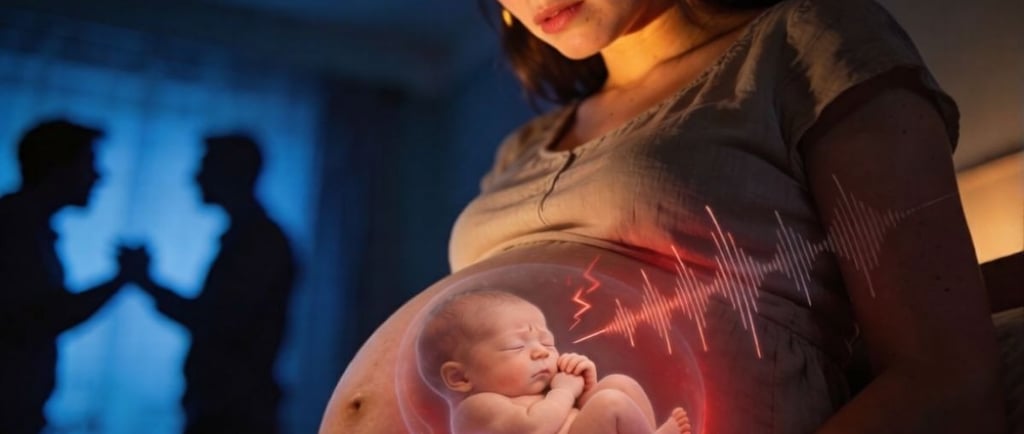
6. It starts before birth: pregnancy under stress 🤰💥
The impact of hostility is not limited to the postnatal environment. Recent reviews show that maternal psychological stress during pregnancy — including verbal aggression, chronic arguments and severe anxiety — is linked to changes in fetal brain development.
Neuroscience studies suggest that prenatal exposure to high stress can alter connections between the prefrontal cortex, amygdala and hippocampus, regions involved in emotion regulation and fear responses. These alterations are associated with a higher risk of behavioral problems, aggression, anxiety and even symptoms related to ADHD later in childhood.
7. Why some babies already carry “emotional scars” at birth 🌧️👶
When pregnancy unfolds in an environment of shouting, humiliation or constant tension, the mother’s body releases stress hormones like cortisol, which cross the placenta. Over nine months, this biochemical “bath” can program the baby’s system to expect a threatening world, leaving the child more reactive and emotionally vulnerable.
As a result, not all emotional suffering begins after birth. In many cases, there is already a silent prenatal history of stress that helps explain why some babies seem more sensitive, irritable or insecure from the very start.
8. Long‑term consequences: adult pain without a clear name 🧑🦱🧩
Growing up in a climate of anger and hostility can shape adult life in ways that are hard to trace back. Adults who spent childhood around harsh conflict may develop:
difficulty asserting themselves, for fear of provoking anger;
a compulsive need to please others, to avoid rejection;
chronic anxiety, depression or explosive anger that feels “rootless.”
Because many early experiences occurred before conscious memory, people often do not connect their current struggles with their early environment — but the brain and body still carry those traces.
9. What parents and caregivers can do: practical steps 💡💗
Care for your own emotional health: therapy, support groups and self‑care reduce the risk of taking frustration out on children.
Avoid intense fights in front of kids: disagreement is normal; humiliation, screaming and threats are not.
Repair after rupture: if you lost your temper, apologizing and explaining in simple language helps restore a sense of safety.
During pregnancy: seek psychological support when there is severe conflict, verbal aggression or ongoing anxiety.
Small changes in the emotional tone at home can have a bigger impact than any expensive toy, course or app.
10. Critical and constructive conclusion: what this science asks of us now 🧠🌱
Research from the University of Washington and other institutions makes one point crystal clear: babies and toddlers are not blank slates indifferent to their surroundings; they are exquisitely sensitive emotional detectors who will do almost anything to avoid adult anger. Ignoring this reality means allowing cycles of suffering to continue from pregnancy into adulthood.
Constructively, these findings are not about blaming parents, but about pushing society to better support them: offering mental health care for pregnant women, emotional education for families, and policies that reduce domestic violence and chronic stress. In a rushed, noisy world where everything feels urgent, perhaps the most radical act is to soften our tone, relax our face and turn our own presence into the safest and most valuable “toy” a baby can have. 👶💞
Research sources (selected) 📚
University of Washington – “Better safe than sorry: Babies make quick judgments about adults’ anger” (2016)
Repacholi et al. – “Emotional Eavesdropping: Infants Selectively Respond to Indirect Emotional Signals” (2007)
I‑LABS / UW – “Infant, Control Thyself” and related work on toddlers regulating behavior to avoid adult anger
Graham et al. – “What Sleeping Babies Hear: An fMRI Study of Interparental Conflict” (2013)
Recent reviews on maternal stress in pregnancy and child brain development in Neuroscience & Biobehavioral Reviews and related journals (2022)
Contato
Apoio e dicas sobre saúde mental.
Redes
+55 11980442159
© 2025. All rights reserved.