
🌍✝️ “Didn’t Like It, Started Another Church?” What No One Tells You About Christian Denominations
Different Christian denominations did not simply appear because “someone didn’t like a church”; they emerged from complex mixes of faith, conflict, power, culture and genuine attempts to reform what seemed broken.
✍️ Autor: André Nascimento
12/24/20255 min ler
1. Beyond the Meme: The Story Is Not That Simple 🧩
origin of Christian denominations
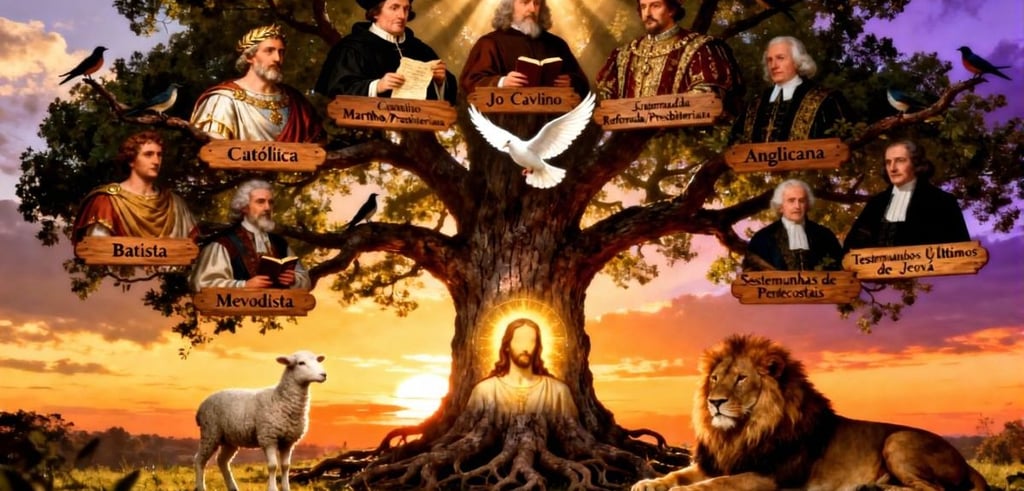
There is a viral list claiming: Constantine didn’t like Jewish laws and “founded” the Catholic Church, Luther didn’t like Catholics and founded Lutherans, Calvin and Knox didn’t like Lutherans and founded Presbyterians, Henry VIII didn’t like Catholic marriage rules and created Anglicans, and so on with Baptists, Methodists, Adventists, Mormons, Jehovah’s Witnesses and Pentecostals. It is funny — and very misleading.
Historical studies show that denominations formed through a blend of theological debates, political struggles, moral reform movements and, yes, human conflicts and ego. Reducing everything to “they didn’t like it and opened a new brand” hides both the pain and the sincerity present in many of these shifts.
2. Constantine and Christianity: No, He Didn’t “Invent the Catholic Church” 🏛️
Constantine and Council of Nicaea
Emperor Constantine in the 4th century did not create the Catholic Church from scratch. Christianity already existed as a persecuted movement. What he did was legalize it (Edict of Milan, 313) and call the Council of Nicaea (325), which shaped the Nicene Creed and tried to unify doctrine in the empire.
Saying “Constantine didn’t like Jewish laws and founded the Catholic Church” oversimplifies a long separation process between Judaism and Christianity that had started much earlier, and ignores centuries of church development before and after him.
3. The Reformation: Did Luther Just “Not Like” the Catholic Church? 📜⚡
Protestant Reformation
Martin Luther did not just “get annoyed with Rome” and open a new church franchise. He publicly challenged issues like the sale of indulgences and abuses tied to money, power and corruption, arguing that salvation is by faith and that Scripture must be accessible to ordinary people.
His protests sparked the 16th‑century Protestant Reformation, which gave rise to Lutheran, Reformed, Anglican and other traditions. Behind this, there was real spiritual pain: believers who felt betrayed by a church that no longer looked like the Gospel it preached, plus rulers eager to limit Rome’s power.
4. From Calvin to Knox: Presbyterians and the Reformed Tradition 🔄
Reformed theology
John Calvin in Geneva developed a theology centered on God’s sovereignty, predestination and strict moral discipline. John Knox carried these ideas to Scotland, where Presbyterianism took shape. This was not simply “we don’t like Lutherans”; there were deep disagreements about communion, church government and how biblical law should shape society.
These debates may sound technical, but they influence how people think about freedom, responsibility, discipline and grace — topics that still touch many believers’ struggles with guilt, fear and acceptance today.
5. Henry VIII and Divorce: The Anglican Church Is More Than a Broken Marriage 💍👑
Church of England and politics
Henry VIII did, in fact, break with Rome after the Pope refused to annul his marriage, and that split triggered the birth of the Church of England. But reducing this to “he couldn’t remarry, so he founded a church” ignores the larger picture: battles over land, power, national identity and how much influence the Pope should have over English affairs.
Meanwhile, ordinary believers were left asking: “Which church is right?”, “Where is God in all this?”. Those questions echo in anyone today who feels caught between church fights while simply trying to follow Christ.
6. Baptists, Methodists and the Desire for a More Coherent Faith 💧🔥
Baptists and Methodists
Baptists emphasized believer’s baptism (not infant baptism) by immersion and local church autonomy; Methodists, shaped by John Wesley, focused on disciplined spiritual practice, holiness in everyday life and active evangelism.
Again, it wasn’t just “they didn’t like Anglicans”; it was a sense that faith needed to be lived more seriously and personally. Many felt large, established churches had become too formal, distant or morally compromised, a feeling that still pushes people away from institutions today.
7. Adventists, Mormons and Jehovah’s Witnesses: Hunger for Prophecy and Ultimate Meaning ⏳📖
19th‑century restorationist movements
In the 19th century, movements like Seventh‑day Adventists, Latter‑day Saints (Mormons) and Jehovah’s Witnesses emerged during intense interest in end‑times prophecy, Bible study and disappointment with existing churches.
Adventists (influenced by William Miller, then Ellen G. White) stressed Christ’s return and Saturday as Sabbath.
Latter‑day Saints (Joseph Smith) claimed additional revelation (Book of Mormon) and a restoration of the “true church”.
Jehovah’s Witnesses (Charles Taze Russell) rejected some mainline doctrines (like the Trinity) and offered a distinct eschatology.
Behind these movements lies another ache: the sense that the churches people knew did not answer their deepest questions about destiny, justice and what happens at the end of history.
8. Pentecostals: The Cry for Experience, Not Just Doctrine 🔥🙌
Pentecostalism and spiritual experience
In the early 20th century, Pentecostal movements arose emphasizing direct experiences with the Holy Spirit — gifts, healings, speaking in tongues. Many leaders and members had roots in older churches but felt those spaces were dry, intellectual and disconnected from everyday suffering.
The pain here is spiritual hunger: the desire to feel God, not only to debate theology. Alongside genuine renewal, however, came new problems: emotional manipulation, prosperity abuse and spiritual showmanship, which in turn created fresh wounds and new divisions.
9. Caught in the Crossfire: The Pain of Those Who Just Want to Walk With God 😔🙏
religious confusion and spiritual homelessness
Between Catholics, Lutherans, Reformed, Anglicans, Baptists, Methodists, Adventists, Mormons, Jehovah’s Witnesses, Pentecostals and many more, ordinary believers often feel lost. Who is right? Which is the “true church”? If each says something different, where can I find peace?
This confusion is not theoretical. Many people have left churches wounded, shamed or afraid of God because of harsh preaching, power abuse, internal fights and scandals. Church history is not just something in books; it’s a living wound for those who looked for the sacred and found war, ego and division instead.
10. Call to Action: Less Labels, More Honest Spirituality 💬❤️
sincere spiritual search
If you feel lost in this denominational maze, one helpful shift is to ask not only “which label is correct?” but also “where does this faith make me more human, more just, more compassionate?”
Watch less the marketing, and more the fruits.
Be cautious with communities that only attack other churches.
Look for spaces that welcome questions instead of demanding blind obedience.
💬 Call to action: share this article with someone confused by so many Christian options. And for your own journey, give yourself permission to study, ask, listen to different stories and build a deeper, more personal relationship with God and your conscience.
Conclusion 💭✨
In the end, the joke “didn’t like it, started another church” hides something heavy: behind every split lies a mix of sincere search for God, power struggles, historical trauma and human limitation. No tradition is perfectly pure; each carries light and shadow.
The hard but freeing question is: will you spend your life defending a logo and attacking everyone else, or will you let history humble you, push you to study more and move you toward a faith that truly shapes your character and relationships? When you choose honest spirituality over religious pride, something inside you grows up.
Critique of the conclusion 🧐
The conclusion rightly warns about fanaticism and blind loyalty to labels, but it may sound too relativistic to readers from traditions that treat doctrine as central to truth. For them, saying “every church has light and shadow” might feel like “it doesn’t matter what you believe”, which is not accurate: different doctrines do lead to very different ethics, communities and uses of power and money.
Constructive critique to include in the article 🌱
To make the piece more balanced and responsible, it would help to:
Distinguish humility from relativism: make clear that recognizing historical mistakes does not mean “everything is the same”, but that no institution is beyond critique.
Offer practical discernment criteria: invite readers to ask how each community handles money, abuse, transparency and care for the vulnerable.
Encourage serious study: suggest reading historical sources, comparing viewpoints and talking to people from different traditions before making deep decisions.
With these additions, the article not only challenges a shallow meme, but also supports those wounded or confused by religion to walk forward with more awareness, respect and healthy critical thinking.
Research sources 📚
Overviews of Christian denominations and their historical development.
Materials on Constantine, the Council of Nicaea and how imperial politics shaped official Christianity.
Historical guides on the Reformation, Anglicanism, Baptists, Methodists, Adventists, Latter‑day Saints, Jehovah’s Witnesses and Pentecostalism.
Google Publisher/AdSense policies on religion‑related content, emphasizing non‑hateful, educational approaches.
Contato
Apoio e dicas sobre saúde mental.
Redes
+55 11980442159
© 2025. All rights reserved.